
This information may be useful if you are taking HRT and using a GLP-1.
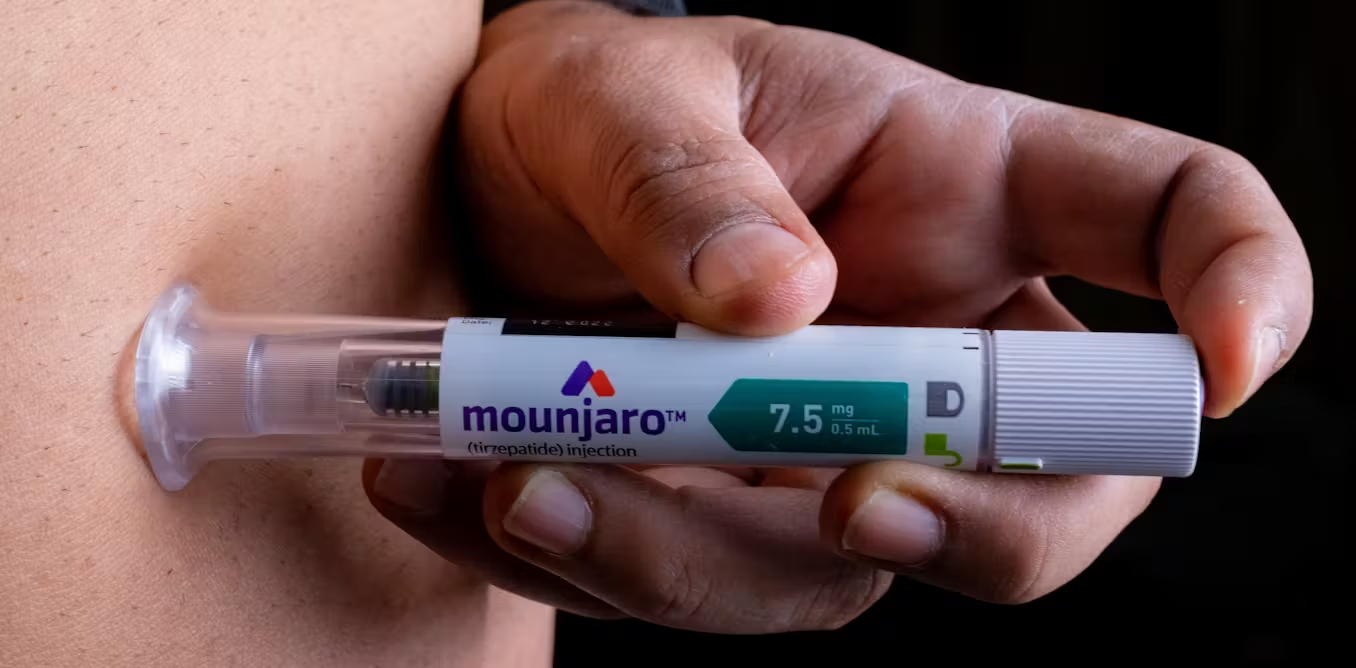
Both Mounjaro® and Wegovy® belong to a class of medications called GLP-1 receptor agonists. They are highly effective for:
- Reducing appetite
- Helping with blood sugar control
- Supporting significant, sustainable weight loss
One of the ways they work is by slowing down the emptying of your stomach (called delayed gastric emptying). While that’s fantastic for helping you feel fuller for longer, it also means any medication you swallow—including oral HRT tablets—may not absorb properly.
The part of HRT we’re particularly concerned about is oral progesterone (e.g., Utrogestan®).
Progesterone plays a vital role in protecting your womb lining (endometrium) if you’re taking oestrogen. If the progesterone isn’t properly absorbed, your womb lining could build up, putting you at risk of heavy bleeding, abnormal bleeding, or even endometrial cancer.
In short:
Your HRT might stop working properly
You might bleed again after years without a period
You might unknowingly increase your risk of womb problems
The British Menopause Society has issued new interim guidelines specifically for women on Mounjaro®, Wegovy® and other GLP-1 medications.
Here’s what you need to know:
- You may need to switch your oral oestrogen to a transdermal route
- Instead of taking oestrogen tablets, we can prescribe patches, gels, or sprays applied to the skin.
- These are absorbed directly into the bloodstream, bypassing the digestive system entirely.
- You may need to switch to a non-oral form of progesterone
- The best option? A Mirena® coil fitted in the womb.
It releases progesterone exactly where it’s needed and gives reliable, consistent protection. - If you stay on oral progesterone (like Utrogestan®) you may need to temporarily increase your progesterone dose.
- When starting Mounjaro® or Wegovy®—or when the dose increases—we may need to double your oral progesterone dose for 4 weeks.
- This helps ensure your womb remains protected during the crucial period when absorption might be reduced.
Please book an appointment to discuss this – never change your dose without first discussing it with a doctor.
If you’re on HRT and Mounjaro®/Wegovy®, please contact us if you notice any of the following:
- Fresh bleeding after months or years without a period
- Spotting between periods
- Unusual pelvic discomfort or bloating
- Changes in discharge or unusual pain
Please don’t ignore any of these symptoms
Early investigation allows us to act quickly and protect your long-term health. If you feel you may be experiencing these or similar side effects, please speak to a healthcare professional.
What are GLP-1 agonists?
GLP-1 agonists include medications such as tirzepatide and semaglutide which may be better known by their different brand names (see below). They are prescription only medications that may be prescribed by a qualified healthcare professional for people with type two diabetes, or to facilitate weight loss. One of the main ways they work is by slowing the rate at which food leaves the stomach (delayed gastric emptying).
| Medication | Brand name examples (commonly known as) |
| Tirzepatide | Mounjaro |
| Semaglutide | Ozempic, Wegovy, Rybelsus |
| Exenatide | Bydureon BCise |
| Liraglutide | Saxenda, Diavic, Victoza |
| Dulaglutide | Trulicity |
| Lixisenatide | Contained in Suliqua |
2. I am taking the pill. Will using a GLP-1 agonist affect my contraception?
This depends on the type of GLP-1 agonist that you are using. If you are using tirzepatide you should use a barrier method of contraception (e.g. condoms) in addition to your pill for four weeks after starting the medication, and for four weeks after any increase in dose. This is because tirzepatide works slightly differently to the other GLP-1 agonists. Alternatively, you may wish to consider another (non-oral) method of contraception whilst using tirzepatide.
There is currently no evidence that semaglutide, exenatide, liraglutide, dulaglutide or lixisenatide reduce the effectiveness of oral contraception (i.e. the combined pill, or the progestogen only pill/ “mini pill”).
3. I have diarrhoea and vomiting with my GLP-1 agonist, and I take the contraceptive pill, what should I do?
Diarrhoea and vomiting are common side effects of the GLP-1 agonists and can reduce the effectiveness of the pill. If vomiting occurs within three hours of taking the contraceptive pill, or severe diarrhoea occurs for more than 24 hours, you should follow the guidance for missed pills. You should consider an alternative non-oral method of contraception or the addition of condoms if diarrhoea or vomiting persists.
4. What about non-oral methods of contraception e.g. the coil, implant, injection, patch or ring, could these be affected by GLP-1 agonists?
There is no reason to believe that GLP-1 agonists affect methods of contraception that are not taken by mouth, so it is okay to use any of these options. No extra precautions are needed when using these methods of contraception alongside a GLP-1 agonist.
5. I am planning to switch from one type/brand of GLP-1 to another, does the contraception advice remain the same?
If you are switching to tirzepatide from ANY other GLP-1 agonist then you should use a barrier method of contraception (such as a condom) for four weeks after the switch, and for four weeks after any increases in dose, while also continuing your oral contraception. Alternatively, you may wish to consider changing to a non-oral method of contraception whilst using tirzepatide.
6. I need emergency contraception and I’m taking a GLP-1 agonist; will it work?
We don’t know yet if oral emergency contraception is affected by GLP-1 agonists. The copper IUD (coil) is the most effective method of emergency contraception and is not affected by diarrhoea and vomiting. If you require emergency contraception, please tell your healthcare practitioner about all other medications you are taking, including GLP-1 agonists.
7. Can I take a GLP-1 agonist during pregnancy?
It is important to use effective contraception whilst taking a GLP-1 agonist, as these medications should not be used in pregnancy. If you become pregnant whilst taking one of these medications it is important to discuss this with your doctor.
GLP-1 agonists should also be avoided for a few weeks prior to a planned pregnancy. The table below shows the number of weeks recommended to have stopped the medication prior to a planned pregnancy (washout period), for some of the GLP-1 agonists.
| GLP-agonist | Washout period |
| Tirzepatide | One month |
| Semaglutide | Two months |
| Exenatide | 12 weeks |
This patient information leaflet has been written by the Faculty of Sexual and Reproductive Healthcare (FSRH). The advice given is based on FSRH recommendations, which can be found at FSRH.
The document is for information only and should not be a substitute for seeking medical advice. Decisions regarding your contraception choices should always include discussion with a healthcare professional, particularly if you have any questions or concerns. No contraception is 100% effective, and there is always a risk of pregnancy. The Faculty of Sexual and Reproductive Healthcare bears no liability for the choices an individual makes regarding contraception or the outcome of their decision.